
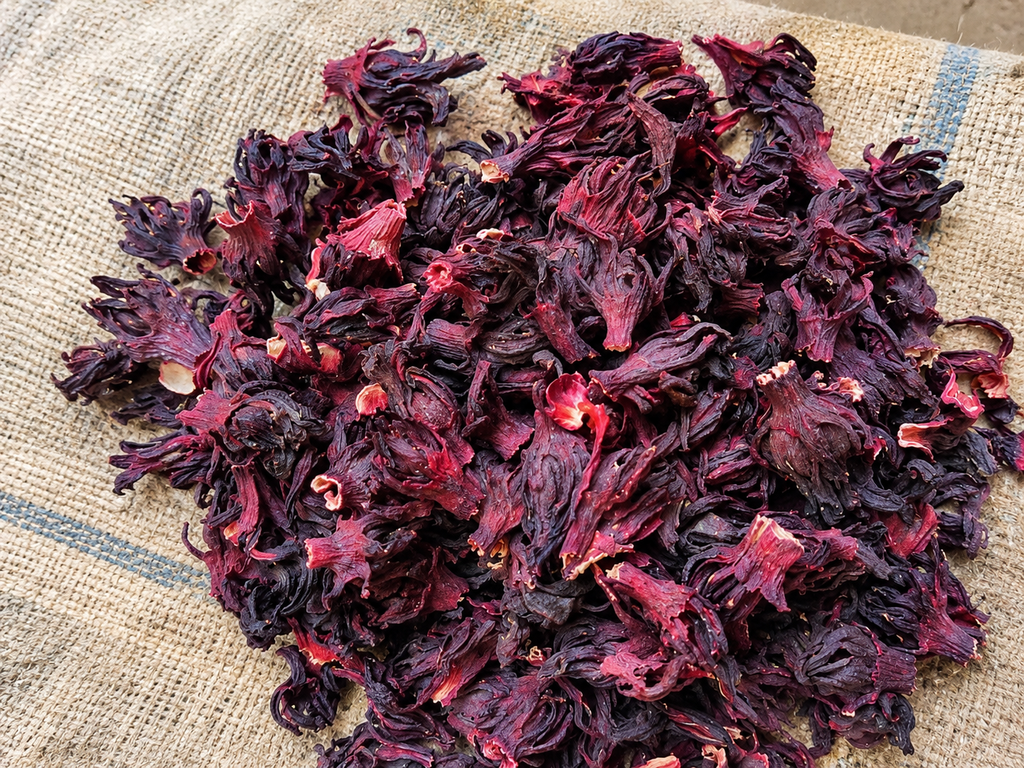
An agricultural product does not create value in isolation. Between the field and the final consumer lies a network of people, businesses, and activities that gradually transforms a crop into an economic opportunity. Dried hibiscus flower is a clear example of this interconnected process. Known scientifically as Hibiscus sabdariffa, it moves through a chain in which each participant contributes something different, creating opportunities that extend well beyond cultivation.
The real story of an agricultural commodity is not only what is harvested, but how many lives and industries it can connect.
The Farmer Starts the Chain
Everything begins with cultivation.
Farmers provide the foundation through their land, labor, agricultural experience, and commitment to producing the crop. Their work creates the raw material upon which every later stage depends.
Without the first link, there can be no wider chain.
Processing Adds Another Layer
Once harvested, hibiscus enters a new stage.
Activities such as drying, sorting, handling, and preparation help transform agricultural output into a form suitable for subsequent use.
This stage creates additional economic activity while preparing the product for its next destination.
Businesses Create Connections
Commercial organizations help connect agricultural production with industries that need botanical ingredients.
They bring together different participants, coordinate commercial activities, and create pathways through which agricultural products can move from producers toward users.
The marketplace becomes the bridge between production and application.
Manufacturers Give the Ingredient Purpose
A dried botanical ingredient can take on many different roles once it reaches manufacturing environments.
Hibiscus may become part of:
- Beverage formulations
- Herbal infusion products
- Food preparations
- Botanical blends
- Specialty ingredient concepts
Manufacturers therefore transform agricultural potential into finished experiences.
Consumers Complete the Journey
The final stage of the chain is the consumer.
People ultimately determine which products remain relevant through their preferences, purchasing decisions, and changing habits.
Consumer interest can influence what businesses produce, what manufacturers develop, and which agricultural ingredients receive greater attention.
Demand travels backward through the entire chain.
Every Link Depends on Another
The agricultural economy works because its participants are connected.
A farmer depends on commercial demand.
A processor depends on agricultural production.
A manufacturer depends on suitable ingredients.
A consumer depends on products that meet expectations.
Each participant has a different role, yet the success of one can influence the others.
Opportunity Multiplies Along the Chain
The economic contribution of dried hibiscus extends beyond the value of the harvested crop itself.
The commodity can generate activity through:
- Farming
- Processing
- Packaging
- Distribution
- Manufacturing
- Retail
This demonstrates how agricultural products can support broader economic participation.
A Crop Can Become an Ecosystem
When a commodity develops enough applications and demand, it begins to support an entire ecosystem around itself.
Dried hibiscus illustrates this principle particularly well. Its journey can involve agricultural communities, commercial organizations, food companies, beverage producers, and consumers across different regions.
One crop can therefore create many interconnected opportunities.
The Chain Will Continue to Evolve
As consumer preferences change and industries develop new products, the role of dried hibiscus within this economic chain can also evolve.
New applications may create new forms of demand. New businesses may enter the sector. Existing participants may discover additional ways to create value.
The chain is never completely finished.
Conclusion
Dried hibiscus flower demonstrates how agriculture can create economic connections far beyond the farm. From cultivation and processing to manufacturing and consumption, each stage contributes to a wider network of opportunity. Hibiscus sabdariffa is therefore not simply an agricultural commodity it is part of a connected economic chain in which one crop can bring together people, businesses, industries, and consumers across the world.