
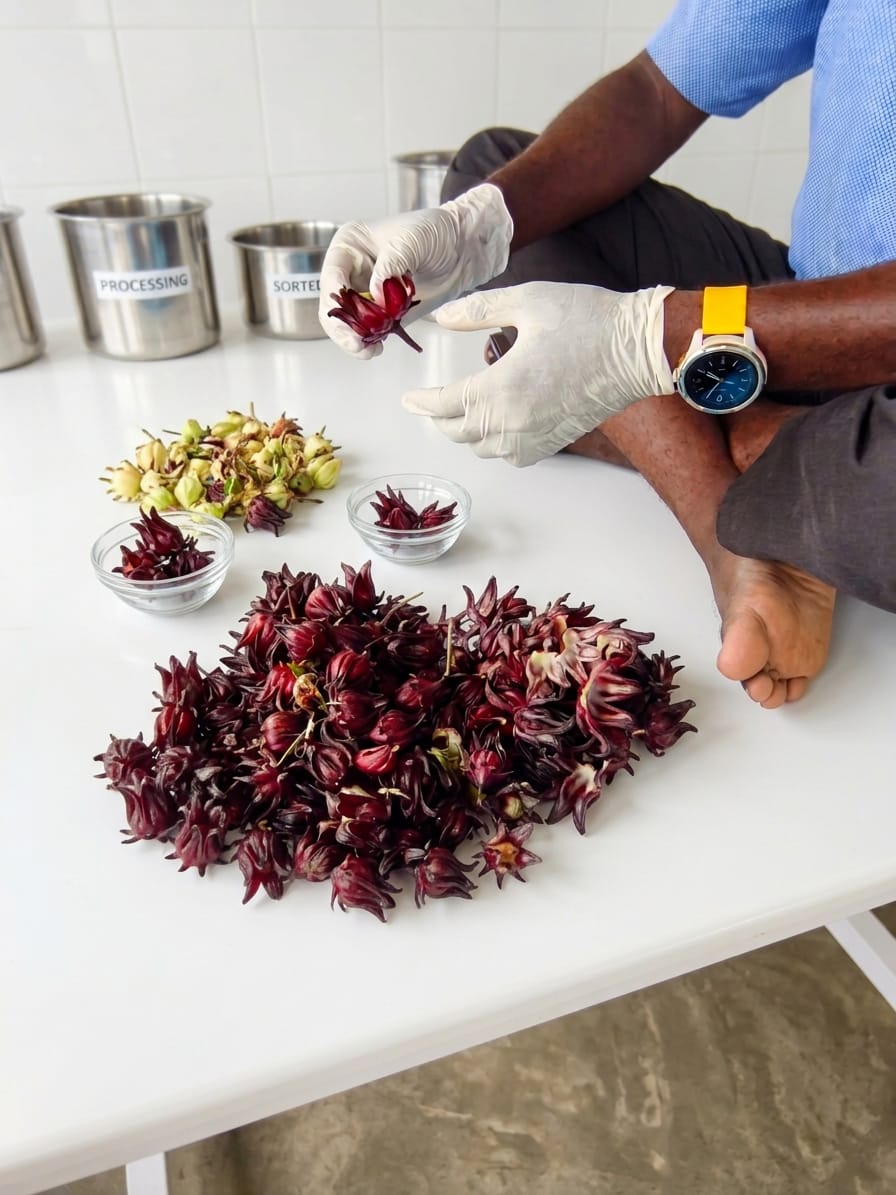
- The First Hours After Harvest Matter
- Drying Changes the Product
- Sorting Gives the Product Greater Uniformity
- Storage Begins Before Export
- Packaging Creates a Protective Barrier
- Transportation Adds New Challenges
- The Importance of Lot Identification
- The Buyer’s Warehouse Is the Next Link
- Every Stage Can Affect the Final Result
- Why the Complete Journey Matters
- Protecting What Was Produced
The journey of dried hibiscus does not end when the calyxes are harvested. Between the field and the buyer’s warehouse, the product passes through several stages that can influence its final condition.
For Hibiscus sabdariffa, careful post-harvest handling is important because drying, sorting, packaging, transportation, and storage all contribute to how the finished material reaches its destination.
The First Hours After Harvest Matter
Once hibiscus is harvested, handling decisions begin to shape the final product.
Fresh plant material contains considerably more moisture than the finished dried product. It therefore needs to be handled appropriately before and during drying.
Delays, poor ventilation, excessive exposure to contamination, or unsuitable handling conditions can affect the material before it becomes a finished dried ingredient.
Good post-harvest management starts immediately rather than only after processing.
Drying Changes the Product
Drying is a fundamental transformation in the production of dried hibiscus.
The objective is to reduce moisture sufficiently for the intended storage and use while maintaining desirable characteristics such as appearance and physical condition.
The drying environment, airflow, duration, and handling practices can all influence the final result.
Once drying is complete, the material should be protected from conditions that could cause unwanted moisture uptake.
Sorting Gives the Product Greater Uniformity
Dried hibiscus may contain natural differences in size, shape, and physical condition.
Sorting helps separate unwanted materials and organize the finished product according to the agreed requirements.
Depending on the specification, this may involve removing excessive stems, leaves, foreign materials, or unsuitable pieces.
For buyers, sorting is particularly relevant when a consistent raw material is needed for further processing.
Storage Begins Before Export
A common misconception is that storage only matters once the goods arrive at the buyer’s warehouse.
In reality, the product may spend time in storage before shipment.
Dried hibiscus should be kept in a clean, dry, appropriately ventilated environment and protected from excessive humidity, heat, pests, and contamination.
Packages should also be arranged so that they can be inspected and handled without unnecessary damage.
Packaging Creates a Protective Barrier
Once dried hibiscus is packed, the packaging becomes an important part of maintaining its condition.
Sacks, liners, and other suitable materials can help protect the product from environmental exposure.
The selected packaging should correspond with the product’s physical form, transportation requirements, and the buyer’s specifications.
For bulk shipments, consistent packaging also makes weighing, counting, loading, and receiving easier.
Transportation Adds New Challenges
A product can leave the warehouse in good condition but still face challenges during transportation.
Long-distance shipments may encounter changes in temperature and humidity. Packages may also experience repeated movement during loading, unloading, and transit.
This is why container preparation and loading practices matter.
The shipping container should be suitable for the cargo and free from conditions that could negatively affect the product.
The Importance of Lot Identification
A clear lot number can connect the physical product with its production and quality records.
This information can help identify when the product was processed, which batch it belongs to, and which documentation relates to it.
For international buyers handling multiple shipments, reliable lot identification makes inventory management and traceability considerably easier.
The Buyer’s Warehouse Is the Next Link
When the shipment arrives, proper receiving procedures help preserve the work already completed.
The buyer may inspect the packaging, confirm quantities, examine the condition of the shipment, and organize the material according to internal storage procedures.
The product should not be left exposed unnecessarily after unloading.
Good warehouse management continues the protection that began at the supplier’s facility.
Every Stage Can Affect the Final Result
Dried hibiscus quality is not determined by a single event.
Cultivation influences the raw material. Harvesting affects what enters processing. Drying determines much of the finished condition. Sorting improves uniformity. Packaging provides protection. Transportation introduces additional handling. Storage determines how well the product remains in condition over time.
This makes post-harvest management a connected process rather than a collection of unrelated activities.
Why the Complete Journey Matters
For a buyer, looking only at the final appearance of dried hibiscus provides limited information about how the product reached that point.
A more complete understanding considers the journey from harvest through delivery.
Questions about drying practices, packaging, lot identification, storage, and transportation can help establish a clearer picture of how the material has been handled.
For suppliers, maintaining consistency across these stages can strengthen the reliability of commercial shipments.
Protecting What Was Produced
Producing dried hibiscus requires agricultural effort, processing, labor, and careful handling. Protecting the finished product after harvest ensures that this work is not undermined during the later stages of the supply chain.
From the first handling after harvest to the moment the bags are opened at the buyer’s facility, every stage has a role.
The strongest approach is straightforward: dry the material properly, handle it carefully, keep it protected, identify each lot clearly, and maintain suitable conditions throughout its journey.
That is how dried Hibiscus sabdariffa can move from an agricultural harvest to a dependable raw material for buyers around the world.